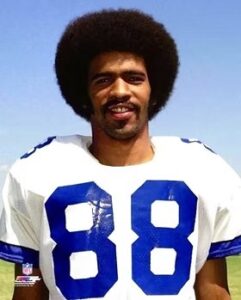
It is with heavy hearts that fans of Dallas Cowboys and lovers of football history mourn the reported passing of former star wide receiver Drew Pearson at the age of 73.
His name conjures memories of clutch catches, unforgettable “Hail Mary” moments, and a career that helped define an era of Cowboy greatness. As news of his death spreads, tributes from across the league and beyond underscore the profound mark he left on teammates, fans, and the entire sport.
Pearson’s legacy is nothing short of legendary. Over 11 seasons (1973–1983) with the Cowboys, he rewrote the team’s record books: for a time, he stood as the franchise’s all-time leader in receptions (489) and receiving yards (7,822).
He earned the respect of teammates and rivals alike for his consistency, determination, and ability to deliver under pressure — qualities that earned him the affectionate moniker “Mr. Clutch.”
One of the most iconic plays in NFL playoff history forever cemented Pearson’s place in legends: the so-called “Hail Mary” catch from quarterback Roger Staubach in the 1975 playoff game vs. the Minnesota Vikings — a 50-yard reception that sealed a dramatic win and became emblematic of Pearson’s uncanny knack for big-game heroics.
Over the course of his career, Pearson played in seven championship games and three Super Bowls, bringing home a ring in Super Bowl XII following the 1977 season.
But beyond the statistics and the Super Bowl appearances, what many remember most is the impact Pearson had on people — teammates, coaches, and fans alike.
Known for his humble nature, quiet confidence, and football IQ, he never sought the spotlight. Instead, he let his performance on the field and his integrity off it speak for him.
His efforts culminated in his selection to the Cowboys’ Ring of Honor in 2011 — a long-overdue recognition of his contributions to the franchise’s storied history.
Pearson’s journey wasn’t without hardship. In March 1984, a tragic car crash — in which he was driving — left him with severe liver injuries and tragically claimed the life of his younger brother.
That accident prematurely ended his playing career. Though he survived physically, the emotional weight and trauma stayed with him. Yet, through it all, he remained a respected — and deeply beloved — figure in the Cowboys community and the broader NFL family.
As news of his passing spreads, fans and former teammates are already mourning. They are sharing memories of his masterful routes, his clutch performances, his unassuming humility, and the dignity with which he carried himself both on and off the field. For many, Drew Pearson embodied what it meant to be a “Cowboy” — grit, grace, and greatness.
About the Author